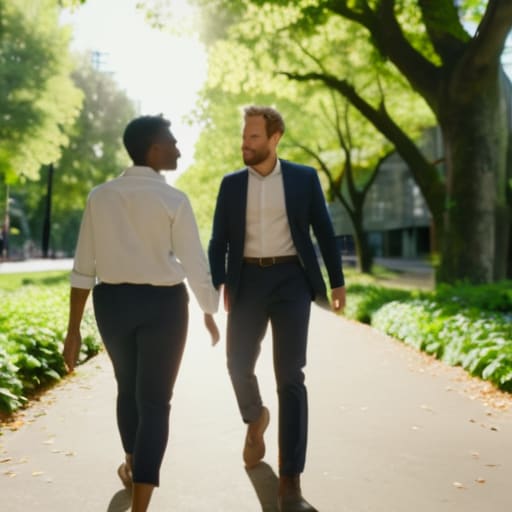
I remember sitting in a glass-walled boardroom during my final years as a Chief Innovation Officer, staring at a lukewarm espresso and feeling my brain turn to absolute mush. We were trying to “disrupt the industry,” but all we were doing was suffocating under the weight of fluorescent lights and the stagnant air of a stuffy conference room. It’s a total myth that high-level strategy requires a mahogany table and a formal agenda; in fact, I’ve found that the most profound breakthroughs happen when you actually move. I’m obsessed with understanding how walking meetings change a working day, because I’ve seen firsthand how a simple stroll around the block can shatter a mental block that three hours of sitting simply couldn’t touch.
I’m not here to sell you some productivity cult or a way to “hack” your biology with expensive gadgets. Instead, I’m going to share the unfiltered, battle-tested strategies I’ve gathered from twenty years in the corporate trenches. We’ll dive into how to transition from sedentary stagnation to kinetic creativity without losing your professional edge. Consider this your roadmap to reclaiming your cognitive energy and reimagining your workflow through movement.
Walking Meetings vs Traditional Office Meetings a Paradigm Shift

When we compare walking meetings vs traditional office meetings, we aren’t just talking about a change in scenery; we are talking about a fundamental shift in how we process information. In those stuffy, windowless conference rooms I spent years navigating during my CIO days, the air often feels heavy with unspoken hierarchies and the stagnation of “business as usual.” We sit, we stare at slide decks, and we subconsciously mirror each other’s rigid postures. But when you step outside, those invisible walls crumble. Movement breaks the mental loops that keep us stuck, allowing for a flow of ideas that a mahogany table simply stifles.
I’ve always found that there is a profound link between creative thinking and physical activity. In my virtual reality world-building projects, I realize that stillness is often the enemy of innovation. By reducing sedentary behavior at work, we aren’t just checking a wellness box; we are priming our brains for high-level strategic leaps. Instead of a static exchange of data, a walk turns a meeting into a dynamic journey, transforming a routine check-in into a catalyst for genuine breakthrough thinking.
Reducing Sedentary Behavior at Work Through Intentional Movement
Let’s be honest: most of us spend our days tethered to a desk, staring at screens until our eyes glaze over and our energy levels hit zero. It’s a silent productivity killer. When we spend hours slumped in ergonomic chairs, we aren’t just physically stagnant; our cognitive gears start to grind to a halt. By focusing on reducing sedentary behavior at work, we aren’t just checking a wellness box—we are actually priming our brains for high-level strategic thinking. I’ve seen firsthand how a simple shift from sitting to strolling can break that mental fog.
If you’re looking to take this concept even further and truly break out of your routine, I always suggest looking for ways to connect with the world outside your immediate professional bubble. When I’m traveling for a conference and need to shake off the mental fog of a long day, I love to find a local spot to just unplug and observe; it’s a great way to find fresh inspiration. For instance, if you find yourself in a new city and want to bypass the tourist traps to truly feel the pulse of the community, you can chat casually with locals to get those authentic, ground-level perspectives. It’s those unexpected human connections that often spark the most brilliant, non-linear ideas for our work back home.
I like to think of it as a “system reboot” for your biology. When you choose to move, you’re injecting oxygen and circulation back into a system that’s been idling for too long. There is a profound link between creative thinking and physical activity that we often overlook in our quest for efficiency. Instead of fighting against our natural need for motion, we should embrace it. Integrating intentional movement into our schedules isn’t a distraction from the work; it is the very fuel that allows us to tackle the complex, futuristic challenges ahead.
My Blueprint for Turning a Simple Stroll into a Strategic Power Move
- Audit your agenda before you lace up your sneakers; if the meeting is just a one-way data dump, keep it digital, but if you need to brainstorm or solve a knotty problem, that’s when you hit the pavement.
- Match your pace to the conversation’s tempo, because I’ve noticed that when we pick up the speed, our ideas tend to catch up, too—just don’t let the momentum turn into a frantic sprint that leaves everyone breathless and unable to think.
- Embrace the “unscripted” nature of the walk by ditching the heavy laptop and the formal slide decks; instead, carry a small notebook or use a voice memo app to capture those lightning-bolt insights that only strike when you’re actually moving.
- Curate your route like you’re building a new level in a VR simulation, choosing paths that offer fresh visual stimuli—whether it’s a local park or just a different street corner—to prevent your brain from slipping into autopilot.
- Master the art of the “soft landing” by scheduling a five-minute buffer after your walk, giving yourself time to transition from that high-energy, creative flow back into the focused execution required for your next deep-work session.
Stepping Into a New Way of Working
At the end of the day, transitioning to walking meetings isn’t just about getting your steps in or avoiding that mid-afternoon slump; it’s about fundamentally reimagining how we connect. We’ve looked at how breaking the physical confines of a boardroom can shatter stagnant thinking and how intentional movement serves as a powerful antidote to the sedentary trap of modern corporate life. By shifting our environment, we aren’t just changing our scenery—we are actively disrupting the autopilot mode that so often stifles true innovation. It turns a standard check-in into a dynamic exchange of ideas that feels less like a chore and more like a catalyst for growth.
As we look toward a future where the lines between technology, creativity, and physical well-being continue to blur, I challenge you to take that first step—literally. Don’t wait for a formal policy change or a complete cultural overhaul to start making a difference. Grab a colleague, lace up your favorite sneakers (maybe even pair them with some of my favorite neon-patterned socks!), and head outside. When we move our bodies, we unlock the imaginative potential required to navigate the complexities of tomorrow. The future of work isn’t found sitting still behind a glowing screen; it’s found in the bold, rhythmic stride of progress.